





- Comments (0)
Blackjack remains one of the most popular casino card games because it gives players more control over the outcome compared to pure chance games. The key to minimizing the house edge lies in blackjack basic strategy, a mathematically proven system that tells you the best decision for every possible hand at the blackjack table.
This guide will walk you through the essentials, including strategy charts, decision-making hierarchy, and important rule variations you should know.
What Is Blackjack Strategy & Why It Works
Blackjack strategy is the optimal way to play every hand in blackjack, based on probabilities. By following it perfectly, you can reduce the house edge to as little as 0.5% (depending on the casino rules). While it doesn’t guarantee you’ll win every hand, it ensures you lose less over the long run.
The Decision Hierarchy (If You Face a Choice)
Before you start memorizing the charts, it’s crucial to understand the order of decisions in blackjack. Always evaluate your options in this sequence:
- Surrender (if allowed)
- Split (pairs)
- Double down
- Hit or stand
Tip: Thinking in this order prevents mistakes like doubling when surrender would have been better. It keeps you aligned with the basic strategy.
Basic Strategy Rules (Hands and the Dealer)

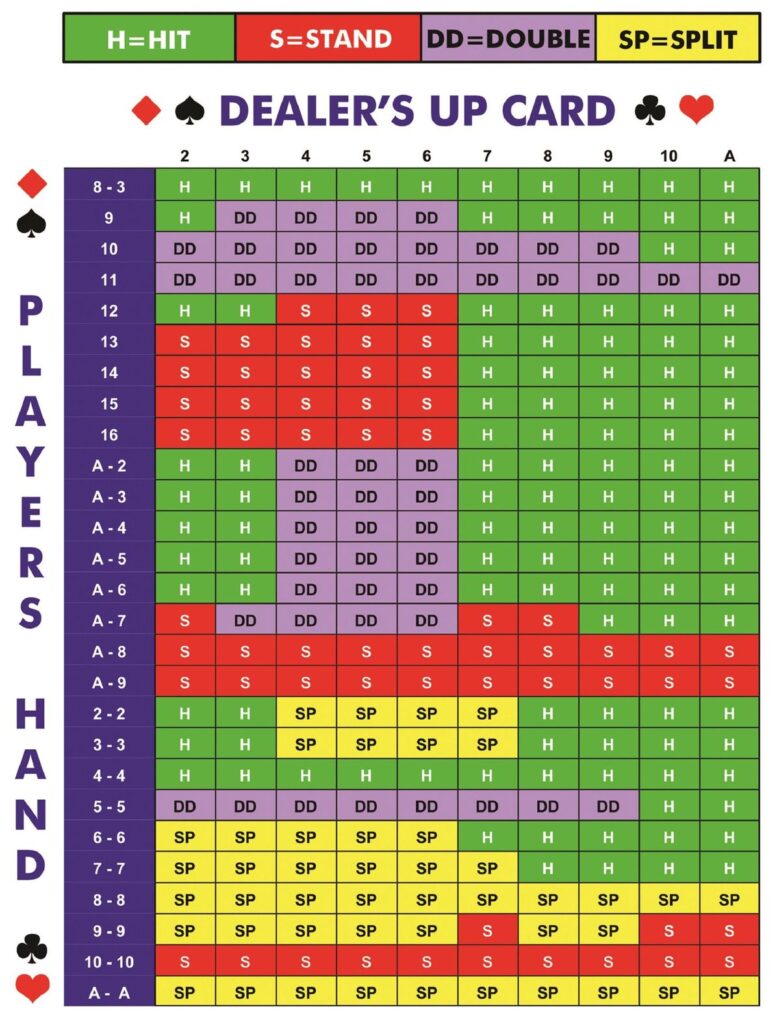
Hard Totals (no Ace, or Ace counting as 1)
- Always stand on 17 or higher.
- Hit on 8 or lower.
- For 9–16, your decision depends on the dealer’s face up card.
Soft Totals (hands with an Ace counting as 11)
- With A,8 or A,9 → always stand.
- With A,7 → stand vs the dealer 2, 7, 8; double vs 3–6; hit vs 9, 10, an Ace.
- With A,2–A,6 → generally double against weak dealer cards, hit otherwise.
Pairs
- Always split Aces and 8s.
- Never split 5s or 10s (face cards included).
- For other pairs, check the dealer’s face up card (e.g., split 2s vs 2–7).
Rule Variations That Matter
Not all blackjack games are created equal. Blackjack strategy shifts depending on the table rules:
- On soft 17: If the dealer hits soft 17 (H17), the house edge rises slightly, and your doubling/surrendering strategy may change.
- Number of decks: Single-deck blackjack has slightly different optimal plays compared to 6–8 decks.
- Doubling restrictions: Some casinos only allow doubling on 10 or 11, which alters your decisions.
- Surrender rules: Late surrender vs early surrender changes when you should use this option.
- Splitting rules: Whether you can resplit Aces or double after splitting affects strategy.
Pro tip: Always check the table rules before playing, and use the correct blackjack strategy chart for that variation.
"The house doesn’t beat the player. It just gives him the opportunity to beat himself."

Nicholas Dandolos (aka “Nick the Greek”)
Examples of Tricky Hands If You Face the Dealer
- Hard 16 vs Dealer 10: Basic strategy says to surrender (if allowed), otherwise hit.
- A soft 18 vs Dealer 9: Hit instead of standing.
- Pair of 9s vs Dealer 7: Always split, even though standing on 18 feels safe.
These examples show how much the dealer’s strength matters when deciding what to do with your hand.
Insurance Bets and the Dealer
Insurance bets may seem like protection, but they usually hurt you.
- If the dealer shows an Ace, you can take insurance.
- The payout is 2:1 if the dealer has blackjack.
- But the probability is only ~30%, meaning over time, you’ll lose more than you win.
House edge impact: Insurance bets raise the house edge significantly, which is why most experts say to avoid them.
Double Down for Maximum Value
Doubling down is one of the most profitable parts of blackjack strategy. Example:
- You hold 11.
- If the dealer shows a weak card (like 6), doubling is the strongest move.
- The math shows your hand improves, while the dealer has a high chance of busting.
Limitations of Basic Strategy
While the basic strategy is powerful, it does not overcome the house edge by itself. Over thousands of hands, the casino still has a small edge.
Advanced techniques include:
- Card counting
- Deviations from strategy
- Betting adjustments depending on the dealer and shoe composition
But without basic strategy, you magnify the house edge dramatically.
How to Memorize & Practice Blackjack Strategy
Memorization is key. Even a single mistake per shoe can swing the edge back to the casino. Try these methods:
- Printable charts: Keep a basic strategy chart handy for review.
- Blank drills: Test yourself by filling in charts from memory.
- Flashcards: One side with player hand + dealer upcard, other side with the correct move.
- Mobile apps / simulators: Practice in real time with feedback.
- Verbal mnemonics: Turn rules into phrases (e.g., “Always split Aces and 8s,” “Never split 10s,” “16 against 10, surrender if you can”).
A Soft Reminder: Hands with an Ace
Many beginners misplay a soft hand.
- A soft 17 (A+6) → Always hit if the dealer shows strong cards.
- A soft 18 (A+7) → Flexible: stand vs weak, hit vs strong.
- A soft 19+ → Almost always stand.
Understanding how to handle an Ace is essential, since the dealer’s advantage grows if you misplay these spots.
Blackjack Chart / Cheat Sheet
Final Tips If You Want to Win More
- Learn the decision order first.
- Adjust strategy for the specific table rules (H17 vs S17, surrender allowed, etc.).
- Drill until you make zero mistakes.
- Avoid insurance bets.
- Remember: basic strategy minimizes the house edge, it doesn’t make you a guaranteed winner.
By mastering this foundation, you’ll play smarter, lose less, and prepare yourself for advanced techniques like card counting.