



- Comments (0)
When it comes to winning in poker, knowing your cards is only half the battle. Understanding your poker position is what separates beginners from skilled poker players. Your position at the table determines when you act, what information you have, and how much control you hold over the pot.
Have you heard other poker players talk about "being in position" like it's a good thing? Or "out of position" like it's bad? Here's why different poker positions affect your strategy.
Understanding Poker Positions: From Early to Late
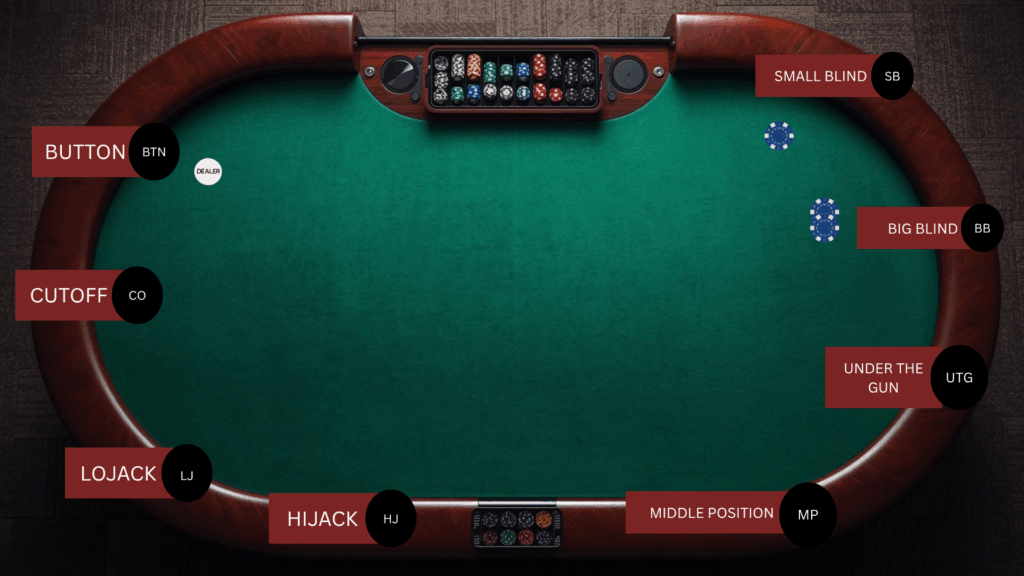
Every seat at the poker table has a name and a purpose. Your poker position is determined based on where you sit to the left of the dealer button. Let’s look at the main positions at the table and how they influence your decisions to play.
Early Position (EP)
- Includes seats like Under the Gun (UTG) and UTG+1.
- These are the first to act preflop, meaning they have less information of the table.
- Because of this, early position players should play tighter, sticking to premium hands like A-A, K-K, Q-Q, and A-K.
Under the Gun literally means the first player to act. It’s the toughest spot because every decision happens before seeing what others will do. Playing too many hands in poker from this seat can quickly drain your stack.
Middle Position (MP)
- Sits to the left of early position.
- You still don’t have much information, but you can widen your range slightly.
- Middle position is one of the transitional spots where you balance caution and opportunity.
Late Position (LP)
- Includes the Cutoff and The Button.
- Acting last is the best position you can have at the table.
- You get to see how everyone else has played before you make your move, giving you control over the pot.
The Button is often considered the best position because you can play more hands, bluff more effectively, and size your bets with better information.
The Blinds
- The Small Blind and The Big Blind (BB) are forced bets.
- The small blind sits to the right of the big blind and acts second after the flop.
- Both blinds are out of position after the flop, making them harder seats to play profitably.
In essence, the earlier the position, players typically play tighter ranges.
“Position is power.”

— Unknown (Poker Maxim)
How Table Size Changes Poker Positions
The number of players in a game drastically affects how poker positions work.
In a full-ring game (9–10 players), you’ll have all the classic positions: Under the Gun, middle seats, the Hijack, Cutoff, and The Button.
But in a 6-max game, the middle seats disappear. You’re often either in early position, late position, or the blinds.
In 4-handed or heads-up play, nearly every player is in an early position or late position every hand. There’s no true “middle” anymore, which means your strategy must adapt. Ranges get wider because you have to act more frequently. Otherwise players risk folding too often and being easily readable.
How Poker Position Impacts Strategy Before the Flop
Preflop strategy is one of the most important fundamentals in poker. Where you sit decides how loose or tight you should open.
Early Position Play
From Under the Gun, your range should be strong. With seven or eight players in the hand still to act, there’s a higher chance someone will wake up with a good hand. That’s why poker players open fewer hands from here.
Hands like A-A, K-K, Q-Q, J-J, and A-K dominate your early position range. Opening too wide can cost you the pot quickly.
Middle and Late Position
By the time you reach the Cutoff or the Button, most of the table would have acted. Here, you can start raising with suited connectors, smaller pairs, and even weaker aces.
From the Button, you control the pot, to act last, and decide how much pressure to apply. It truly is the best position because you can attack limpers (aka squeeze), steal blinds, and react perfectly after the flop.
The Blinds
While the small blind and the big blind are forced to play, they’re always out of position.
- The big blind (BB) often defends wide
- The small blind has it even harder - you’re only halfway invested and always to act first post-flop.
Playing After the Flop: In Position vs. Out of Position
Once the community cards are dealt, poker position continues to dictate your options. Acting after the flop in position gives you valuable information. Acting out of position means guessing and reacting instead of leading.
Being In Position
When you can act last, you can control the pot size. You see what your opponent does before deciding your bet. This helps with bet sizing and bluffing frequency.
Example: You’re on the Button, your opponent is in the big blind. They check after the flop, and you can choose to continuation bet (c-bet) small to pressure weak ranges.
Being Out of Position
If you’re in the small blind or big blind, you’ll be out of position after the flop.
That means you have to act first, often without enough info of the board texture or your opponent’s strength.
How Position Affects Ranges and Decisions Post-Flop
After the flop, ranges and strategy shift dramatically depending on both your seat and your opponent’s.
Let’s say the Under-The-Gun (UTG) villain raises, and the CutOff (CO) hero calls.
- The UTG has a relatively tight range - strong pairs, big aces, and broadways.
- The CO, having position on the raiser, can include suited connectors and smaller pairs to play after the flop with control of the pot.
Post-flop, the Button or late position players can widen their bluffs because they act last.
Meanwhile, early position players, especially Under the Gun, must play straightforwardly since multiple players in the blinds may still to act.
When you’re in position, you can check back for pot control, float flops to steal turns, or raise when your opponent shows weakness.
When you’re out of position, you often need to bet bigger to protect your equity and avoid letting your opponent see free cards.
Summary: Why Position Is the Cornerstone of Poker Strategy
Your position in poker defines everything. Your range, your aggression, and bluff frequency.
- Early positions typically requires discipline and strong hands. You could mix in weaker hands from time to time, to show your opponents that you're not easily readable.
- Late position gives freedom and information.
- The Button is generally considered the best position because you can see everything unfold before deciding.
- The Big Blind (BB) and Small Blind are the hardest spots because you’re out of position after the flop.
Every decision in poker comes down to information. The later you act, the more you know.
So next time you sit at the poker table, remember:
Your cards matter, but your poker position matters more. Master it, and you’ll gain control of the pot, your opponent, and ultimately, your bankroll.