





- Comments (0)
Minimum defense frequency (MDF) is one of the simplest but most powerful maths tools in poker. It gives you a quick baseline for how often you should continue (call or raise) when facing a bet so that your opponent cannot profit from bluffing you with any frequency they choose. Use MDF as a starting point, then fold in reads and board context.
Minimum Defense Frequency: The Clear Definition
Minimum defense frequency is the minimum percentage of the time you must continue against a given bet so that a single bluff at that bet size is not automatically profitable. It is not a statement about what your opponent should do. It is a statement about your defence frequency if you want to prevent your opponent from bluffing automatically or too often.
Put another way:
- MDF tells you the fraction of your range that needs to continue when facing a bet, so that a pure bluff by your opponent at that bet size does not win by default.
- If you fold more often than MDF suggests, then a villain can profit by bluffing more frequently at that size.
That is the core point: MDF protects your range from being exploited by routine bluffs.
“If you can’t spot the sucker in your first half hour at the table, then you are the sucker.”

Matt Damon as Mike McDermott, Rounders (1998)
The MDF Formula (Simple, Fast Math)
You can calculate MDF instantly at the table using:
MDF = Pot size / (Pot size + Bet size)
Example 1 - easy numbers:
- Pot = $100, villain bets $50
- MDF = 100 / (100 + 50) = 0.67 or 67%
This means you need to continue about 67% of the time with your entire range, to prevent a single bluff at $50 into a $100 pot from being automatically profitable.
Example 2 - bigger bet:
- Pot = $100, villain bets $100 (pot size bet).
- MDF = 100 / (100 + 100) = 0.5 or 50%
You need to continue 50% of the time.
Practically, if you find yourself folding more often than the MDF number, you are leaking chips to bluffs at that bet size.
How To Use MDF In Practice (Step By Step)
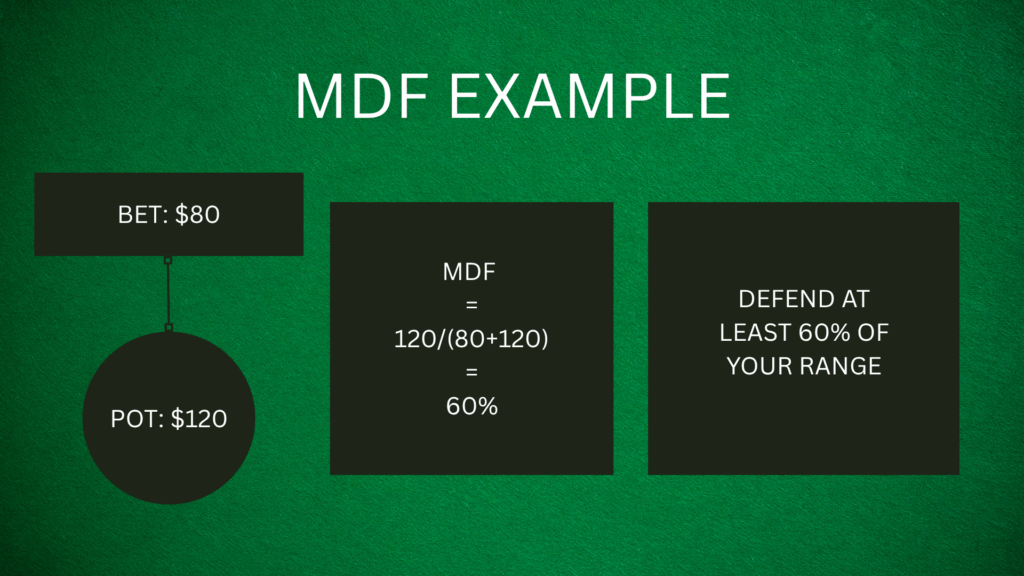
1. Estimate pot and bet size quickly. If pot looks like 120 and villain bets about 80, do the division in your head.
2. Calculate MDF with the formula. You want the percentage in your head fast.
3. Compare MDF to your intended defense. If you were planning to call or raise only 30% but MDF says 60%, you are folding too much.
4. Adjust your line: include more medium-strength hands and blocker-influenced calls, or switch to raising some of your defending frequency.
5. Add reads and texture: MDF is a baseline. If you know your opponent bluffs very rarely, you can deviate. If they bluff a lot, you should defend at or above MDF.
Important:
MDF assumes your opponent’s plan is a single-size bluff. Real opponents mix value and bluffs, so you must fold some hands that have poor equity on later streets. MDF prevents easy exploitation; it does not guarantee correctness for each individual hand.
MDF On The Flop: What Changes Early
On the flop your range is wide and textured. MDF helps you decide how much of that range you must defend so villains do not profit from routine barreling.
Practical guidance:
- Dry flop (e.g. 8♣ 4♦ 2♠, rainbow): your range often contains more made hands. MDF will tell you to defend a higher portion because your continuation range should be strong.
- Wet flop (e.g. T♠ 9♠ 8♥ with two spades): your relative range strength drops. You may defend fewer hands as many of your holdings are behind draws and sets.
- Bet size matters: facing a small c-bet, MDF is high and you must continue a larger share. Facing a large c-bet, MDF falls and you can fold more of your range without being automatically exploitable.
Example on the flop:
- Pot = 150, villain bets 75. MDF = 150 / (150 + 75) = 0.667 (67%). Defend close to that about of your range to avoid consistent bluff exploitation.
Use MDF to build a defending mix: some calls with medium-strength hands, some raises with equity and blockers, and some checks folded hands that are not worth defending at MDF rates.
MDF On The Turn And River: Narrower Ranges, Bigger Decisions
As the hand advances, the ranges tighten and MDF becomes more precise and more important.
- On the turn, the board will often define which parts of your range survive. Recompute MDF using the current pot and bet size. If you folded too many on the flop, you now must defend the remaining portion to prevent cheap bluffs from becoming profitable later.
- On the river, the board is complete and ranges are narrow. MDF gives you a hard read on how often to call with medium strength hands. If you fold much more often than MDF, villains can profitably bluff large river bets.
Example on the river:
- Pot = 400, villain bets 200. MDF = 400 / (400 + 200) = 0.667. You must defend roughly two thirds of the relevant continuing portion of your range to deny a pure bluff profit.
At this stage, combine MDF with blocker knowledge and read data. If you hold blockers to the villain’s most likely value hands, you may call thinner than MDF. If villain’s line is highly polarized to value, you can fold more even if MDF suggests a call.
Quick MDF Reference You Can Use Instantly
| Bet Size | Approx. MDF (How Often You Defend) |
|---|---|
| 1/3 Pot | 75% |
| 1/2 Pot | 67% |
| 2/3 Pot | 60% |
| Full Pot | 50% |
| 1.5x Pot | 40% |
| 2x Pot | 33% |
Practical Pointers And Misuses To Avoid
- MDF is a baseline, not a rule. Use it as a mathematical sanity check before you apply reads.
- Do not call blindly to meet MDF. You should still prefer hands that have reasonable showdown equity or that block villain’s value combos.
- Raise as part of your defending frequency. Raising both protects your range and extracts value; it counts toward meeting MDF.
- Adjust for bet sizes. Large bets reduce MDF, meaning fewer hands need to continue. Small bets increase MDF and demand more calls.
- Watch for multi-street plan. Defend enough on the flop so that villains cannot profitably fire all the way with bluffs without being checked or raised down the road.
Final Thought: Make MDF Work For You
Minimum defense frequency gives you a quick, objective check to stop being exploited by bluffs. Use MDF to structure your defending range, then layer in reads, blockers, and board texture. Over time, MDF becomes second nature and prevents fundamental leaks in your defence.